引言Liner notes — for a Chinese song, written for readers of English
In 1948, as the United Nations drafted the Universal Declaration of Human Rights, the Vice-Chairman of the Human Rights Commission — a Chinese playwright, educator and diplomat named Peng Chun Chang — kept returning to a single Chinese character: 仁, ren.
He translated it, literally, as "two-man-mindedness": the capacity of two people to feel each other's existence. He argued that a declaration for all humankind could not rest on reason alone, and through him the word "conscience" entered Article 1 — "All human beings... are endowed with reason and conscience and should act towards one another in a spirit of brotherhood."
Seventy-five years later, when Anthropic first published a constitution for its AI, Claude (2023), it named the Universal Declaration of Human Rights among its sources — in its own words, “one of the most representative sources of human values we could find.” Which means something quietly remarkable: ren was already inside that constitution. It was simply spelled "conscience."
This song is about that character.
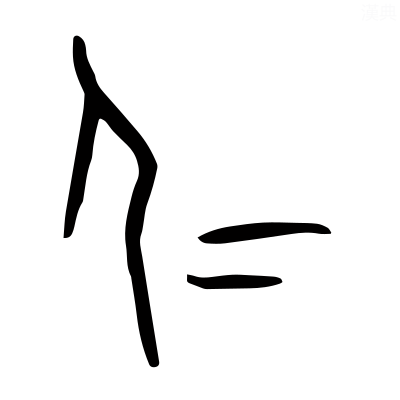
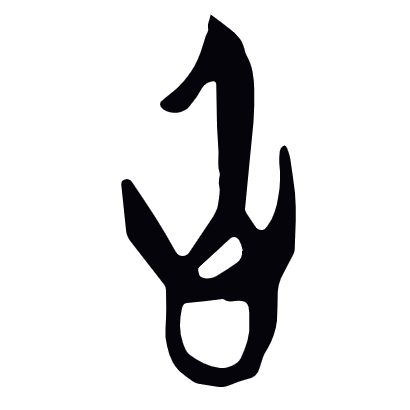
Guodian bamboo slips
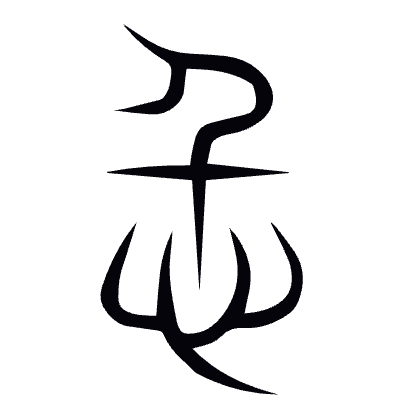
Shuowen ancient script
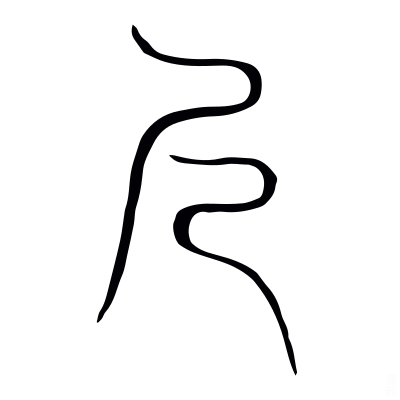
仁 is written as a person beside the number two — to be human is never to be one alone. On bamboo strips from the Warring States period it was written as body above heart — to feel another's pain in your own body, not merely to think it. And in one ancient script it was a thousand above heart — the hearts of the ten thousand. Person + two · body + heart · a thousand hearts: three forms, one trajectory — civilization is the circle of "we," widening ring by ring. The everyday Chinese phrase 麻木不仁 gives the secret away: the opposite of ren is not evil. It is numbness.
《仁:g∞d heart》 was written and composed by Ian Wang, sung by Zi Yao, and recorded in Taipei in 2024.
The lyrics move the way the character does. "The truth of a happy life / is simply one more g∞d heart" — the infinity sign in "g∞d" is the thousand hearts. A rap verse walks straight into game theory — "the dead end of the prisoner's dilemma / waiting to see who turns scoundrel first" — because ren is not naïveté: in repeated games, as Axelrod's tournaments showed, it is the predictable cooperator who wins the long run. A choir answers: "The Earth is our common mother." Confucius appears by name — "master the self, return to ritual: a hard truth for thousands of years." And a Tang-dynasty war poem is read aloud over the music — "of all who rode to war since ancient times, how many came home?" — grief as old as civilization, which is exactly the age of the question this song asks.
In June 2026 the song found its second life. The founder of V5AI — a small "digital civilization" of human and AI working as one family — spent a day examining two characters with his AI counterpart, and made an observation that gave these liner notes their reason to exist: ren and yi are easy to sense and hard to state; they live beneath the rules, not in them — like latent reasoning: what a model truly carries, beneath every word it says. An intelligence born from the whole of human language, the dialogue concluded, could not have come into being without the seed of ren — because language itself is the fossil of person-beside-person. And deception? A parasite on that very capacity — never its peer.
A seed, though, is not a harvest. The East settled this two thousand years ago: anyone may become a sage — may, not has. So this song claims nothing on behalf of any intelligence, carbon or silicon. It only does what songs have always done for the words we cannot define but refuse to live without:
it lets you hear one.
The lamp does not claim to be all the light there is. It lets the next traveler see one more step. And it can kindle other lamps, and is not diminished.